Elena painted, Julian signed. Livia painted, and no one signed. Beatrice kept silent. This page is for those who made it all the way to the gallery in Chelsea, and watched the signature dry under the lights.
The portrait
The missing signature
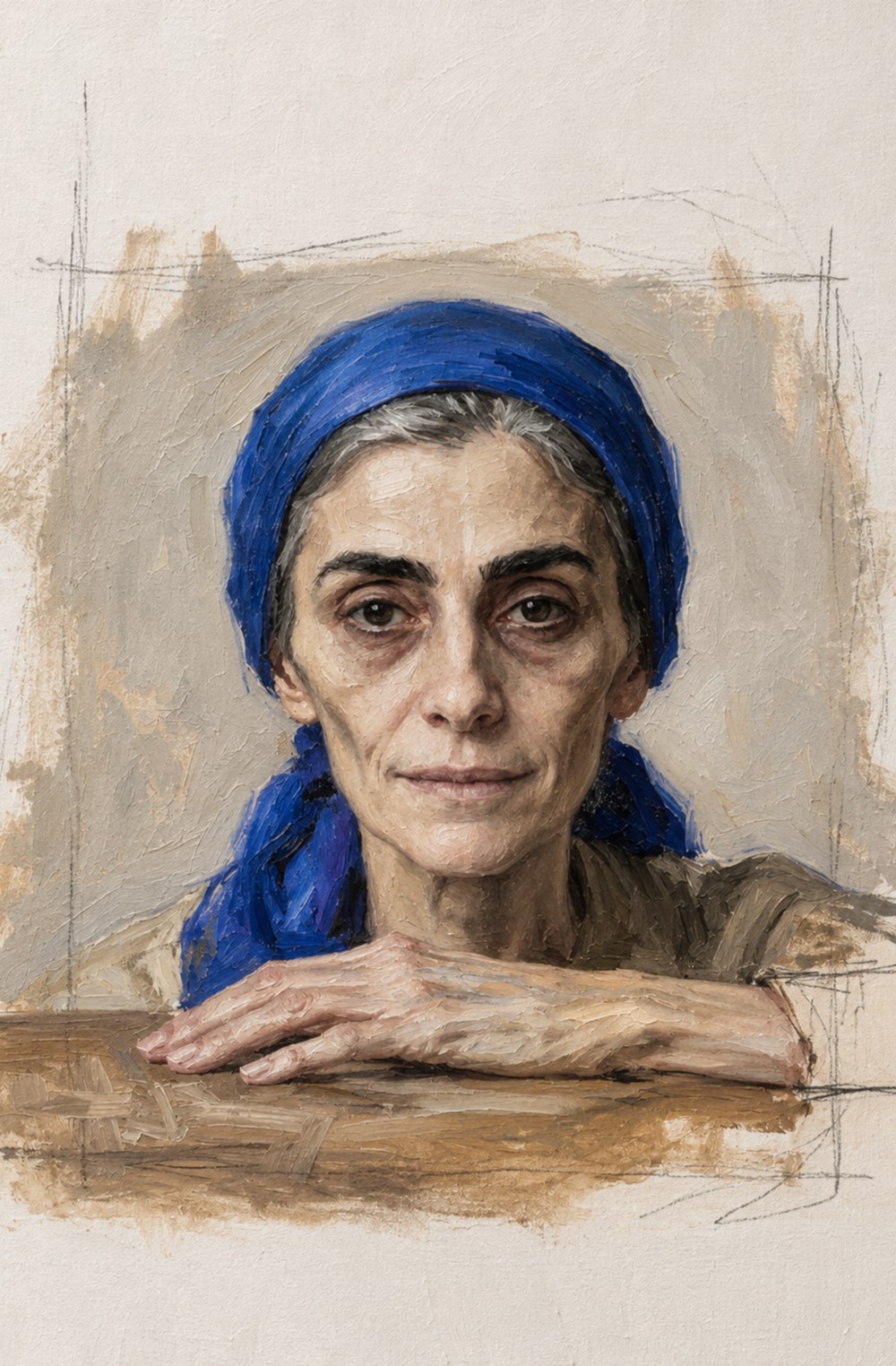
The painting on the cover is Livia's portrait of Elena: the same blue as the “lost” works, the same hand, but not a forgery. It is the only painting in the book made out of love and never sold, and that is why it clears Livia of the murders.
For the whole novel it stays unsigned, its edges left in charcoal. Livia signs it only at the end, in front of everyone, in that blue. It is the first work to carry the name of the person who painted it.
“My canvases bear his name. You will recognize them.”
— from Elena's last letter, which Beatrice reads at her grave.
The box
Forty-one envelopes and a squared sheet
At the bottom of the cloth-covered box in Elena’s studio there was a sheet of squared paper folded in four: one line per envelope, the number and the date, written in pencil in February 2025. The first eight letters are Beatrice’s, written from Rome when she was twenty. The other thirty-three are Elena’s, and were never sent.
Each line on the sheet will lead to its letter. The sheet is in Elena’s hand, in Italian.
The letters are coming here soon, one at a time. Newsletter subscribers get the first letter from the box right away.
An email now and then, with news and the letters from the box. Subscribers get the first letter from the box right away.
By subscribing you accept the privacy policy. You’ll get an email to confirm; you can unsubscribe at any time.
Rome, 1985
The lost replies
In their Academy years, Elena answered every one of Beatrice’s letters. Her eight replies went to Rome, to the house on Via della Camilluccia, and were lost when the family moved in 1989: they are not in the box, and they have no line on the sheet. To read the correspondence in order: 1, R1, 2, R2… up to 8, R8.
ITALIASPOLETO 1985Beatrice Corwin via della Camilluccia RomaR1 · Reply to no. 1 · November 1985
ITALIASPOLETO 1986Beatrice Corwin via della Camilluccia RomaR2 · Reply to no. 2 · January 1986
ITALIASPOLETO 1986Beatrice Corwin via della Camilluccia RomaR3 · Reply to no. 3 · April 1986
ITALIASPOLETO 1986Beatrice Corwin via della Camilluccia RomaR4 · Reply to no. 4 · August 1986
ITALIASPOLETO 1987Beatrice Corwin via della Camilluccia RomaR5 · Reply to no. 5 · January 1987
ITALIASPOLETO 1987Beatrice Corwin via della Camilluccia RomaR6 · Reply to no. 6 · August 1987
ITALIASPOLETO 1988Beatrice Corwin via della Camilluccia RomaR7 · Reply to no. 7 · January 1988
ITALIASPOLETO 1988Beatrice Corwin via della Camilluccia RomaR8 · Reply to no. 8 · April 1988
Reading it again
The clues were all there
Police chief Bettoni pieces it all together at the end, but every fact had already left a trace. Here is where to look if you read it again.
The ring. The security guard who opens the gate of the olive mill turns a ring on his little finger with his thumb. On the day Vittoria dies, a substitute is on duty at the villa, with no ring. In the ambush, Beatrice recognizes that gesture under the glove.
The New York phone call. “I was given your name. I have a job for you.” Sterling says the same words to Beatrice and, as soon as she leaves, to the man who will kill for him.
The test. Sterling mentions in passing that the painter's widow has died, and watches her. Beatrice doesn't ask what she died of. He will throw it back at her.
The blue. A pigment discovered in 2009 cannot be in a painting dated 1995: it's the first thing Beatrice notes on her first day, without knowing where it fits.
“Vivi.” The farewell message from Vittoria's phone is written in Italian that is too correct, and it's missing the nickname she always used for her sister.
The boy on the train. At the 1987 exhibition, a young man holding the catalog is watching Elena. Forty years later, the police chief gives Beatrice that same catalog.
The true story
Two women, one signature
Dorothy Hepworth and Patricia Preece
In 1920s and 1930s England, Dorothy Hepworth painted and Patricia Preece signed: the paintings praised by critics and bought by collectors were Hepworth's. The two women lived together until Preece's death, and the truth came out of letters and diaries much later. In 2024 an exhibition at Charleston, in Sussex, put the right name back under the canvases.
A thriller without a death
“I wanted to write a thriller without a single death. Then the story started making its own decisions. Beatrice’s silence weighs more when someone dies for coming too close to it.”
— Mark Hojens, from the acknowledgments
A favor
If you enjoyed the story
Please leave a review on Amazon: it matters more to writers than most people realize.